



The EU mid-PM job market in 2025?
Still brutal. Still competitive. Still a place where “mid-level PM seeking relocation” might as well be your Tinder hell because everyone is swiping left. (That’s how I imagine CV check)
If you’re mid-PM and searching for your next role, settle in. Here are 3 stories — two perspectives, and tons of insights - 2 from job seekers, and 1 from recruiters. All for you, my fellow PM warriors wandering the job market desert.
Story 1: From Tallinn to Berlin—My 6-Month Emotional Endurance Test
Iurii Teslia - Product Manager with a strong Engineering background
The Background
After 8 years as an SDET, I made the career change to Product Manager within my company in Tallinn. Having built my own products on the side gave me practical experience that would prove invaluable. When I decided to relocate, I set my sights on Central European tech hubs: Krakow, Warsaw, and Prague.
Beautiful cities. Great tech scenes. Cheap beer. What could go wrong?
Ah, yes. Everything.
The Reality Check
Six months. 130+ applications → 4 interviews processes → Zero relocation offers.
The most common response?
“We’re only hiring candidates already based in this location.”
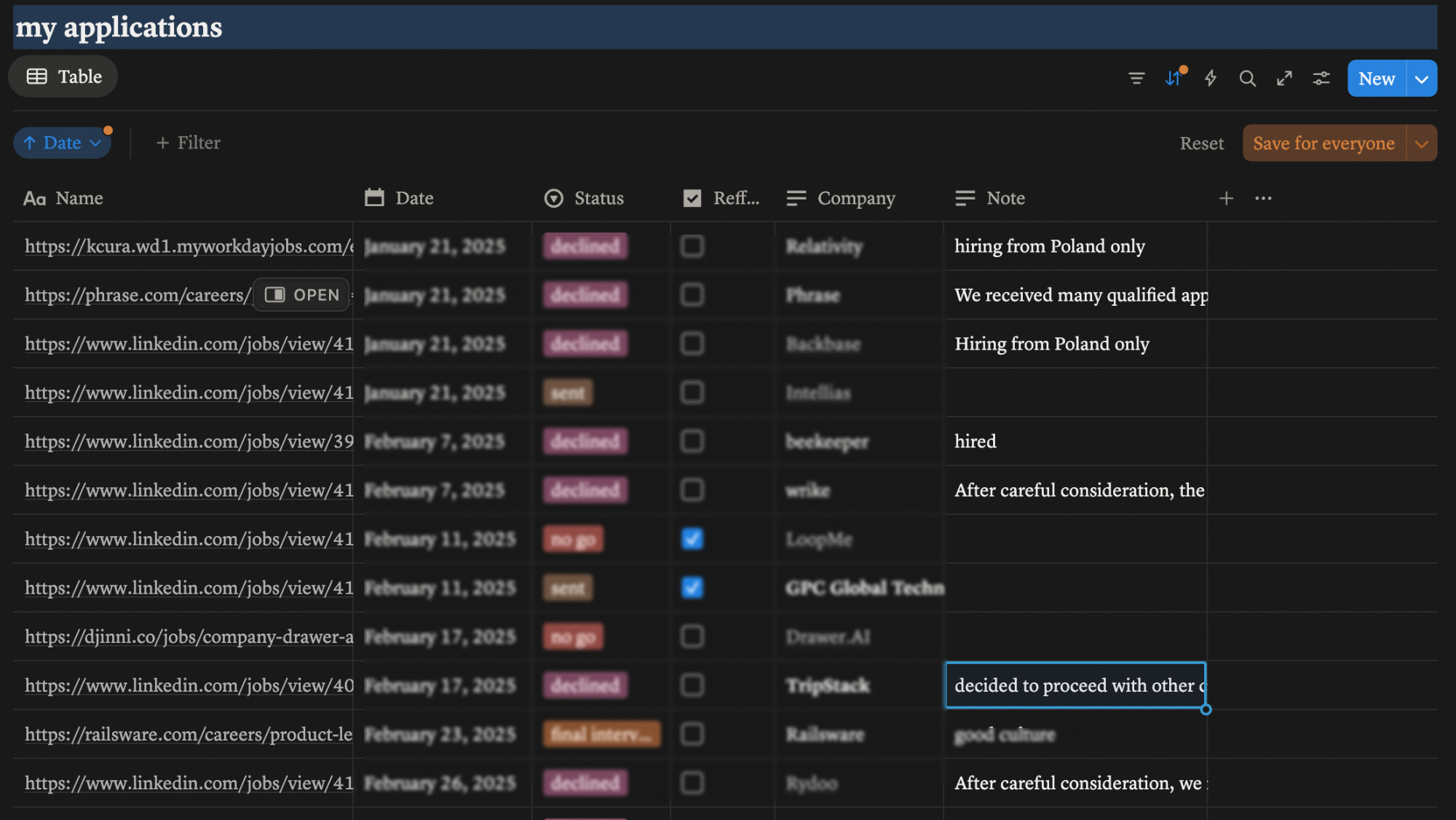
Companies (at least in these locations) no longer needed to offer relocation packages—they had plenty of local talent to choose from. Yet, I have a couple of interviews and even 1 on the final stage. But yet, in the end a local candidate has been chosen.
Side Note - I need to be honest: I was also going through some changes in my personal life during this period. My focus wasn’t entirely on the job search, which likely affected my results. But the market conditions were undeniably difficult.
The Breakthrough
After months of rejection, I pivoted my strategy. I applied to a couple of positions in Berlin—a city I hadn’t initially considered. Another opportunity came from a friend who referred me to their company for a fully remote role with potential relocation (though not to my preferred countries).
What happened next surprised me: within two weeks, I had interview processes running simultaneously at both companies.
Company A (Remote): Just 2 interview rounds, followed by a pre-offer
Company B (Berlin): 7 interview rounds, but remarkably, all compressed into 1.5 weeks once they learned I had another offer on the table
Both companies extended offers. I chose the Berlin position as a Technical Product Manager, finally achieving my relocation goal—just not to the city I originally planned.
Key Takeaways from My Experience
Leverage referrals: Your chances of getting noticed for initial interviews increase dramatically with an internal referral
Build your own products: Side projects strengthen your resume and give you hands-on experience to discuss in interviews
Practice interviewing: Apply to companies you’re less interested in or schedule mock interviews to develop your interview skills
Be flexible with location: Sometimes the right opportunity is in a city you hadn’t considered
Having competing offers accelerates processes: Once I had a pre-offer, the other company moved remarkably fast
Build your network in target locations: Referrals help you get noticed, but personal connections matter even more. Join local communities, speak at conferences, or connect with people at your target companies—it’s absolutely worth the time and effort. (Some of interviews I got though my personal contacts with people in local communities)
Story 2: “The Bathrobe, The Spreadsheet, and The European Job Hunt” — A PM’s Tale
Natalia Tykhonravova - Product Manager, Casino domain
The Funniest Interview & The Red Flags
I still haven’t had a properly funny PM interview — no one has asked me to design a toaster for astronauts yet — but I did once interview a senior developer who joined the call wearing what I thought was a very fuzzy sweater.
Spoiler: it was a bathrobe. A deeply confident bathrobe.
As for red flags, the classics never disappoint:
“Here we love intensity!” → Translation: We burn out together like family.
‘Overtime is normal here.” → Translation: You’ll live here.
Unprepared interviewers reading questions like they found them on ChatGPT five minutes ago.
My Job Search Strategy (a.k.a. My 7-Year Tracking Spreadsheet)
My strategy started with a Google Doc back in 2018. You know how some people track workouts or spending? I track recruiters.
Every company, feedback, stage, salary expectation — documented like I’m preparing for a court case.
Usually, it takes me 2–3 months to land a role, so the spreadsheet keeps me sane.
Over time, I added a portfolio — real projects, with real metrics, so I could say things like:
“Here’s something I didn’t just talk about, I actually did.”
Switching industries? That’s trickier. The portfolio must be adjusted to what the new industry values. For example, for Fintech, it’s more challenging because all my showcased projects are from the iGaming industry.
What Actually Helped Me Get Offers
My winning combo this year was:
A real portfolio (what, why, how, metrics, the whole PM circus)
Stalking interviewers on LinkedIn (professionally!)
Real prep — reading company news, checking their socials, googling things like “What does this company actually do?”
This last time that I was searching for a job, my tactics and approaches included adding a portfolio with projects I’ve done to showcase my expertise based on real data and real use cases. For example, in my portfolio, I tried to answer a few key questions: what was done, why it was needed, what my role was, and what the outcomes were based on success metrics.
Also, one of the tactics is thorough preparation for the interview. It might sound very obvious, but people often don’t google that much about the company or the interviewers. I try to read news about the company, check their social media, and if I have the interviewers’ names, I look them up on LinkedIn to see if we have anything in common or to understand their background. It’s usually very interesting.
“It is crucial to check and understand the product as well. Once CEO asked me do I know their products or not.”
Another tactic is to be as genuine as possible so that the people who are going to hire me can see straight away who they’re dealing with. That way, it’s not a surprise later if I have a weird sense of humor or if I’m very straightforward. It takes a bit of bravery to honestly share past challenges and how I dealt with them, but in the long run, it pays off.
My Advice for Mid-Level PMs Interview Prep
Think long-term, not just “I need a job next month.”
Build your personal brand, share achievements, post certificates, show that you’re alive and learning.
Network even when you don’t need anything. Your future self will thank you.
And please — get curious about different cultures. European teams can include 10 nationalities in one Zoom call. Understanding how people think and work is half of the job.
This time, I prepared for interviews using ChatGPT. I also had a very helpful catch-up with a friend who had started interviewing a couple of months before me, and he gave me great hints about what interviewers might ask and how to prepare.
The only challenge was remembering every detail about each company so I wouldn’t accidentally mention something from one interview in another :)
As for questions that caught me off-guard, one memorable example was when HR asked: “What kind of people are the most challenging for you to work with?” I had to think about it, but I had a good example. I mentioned a conflict that happened a couple of years ago when I was working as a QA Team Lead. I was very honest and explained that at the time I didn’t handle the conflict properly, but I learned a lot from it. I also said that if the same situation happened now, I would approach it differently.
Even if you get a question that surprises you, answering honestly is the best strategy. As long as you show that you can learn from difficult situations and improve over time, it’s totally fine. Making mistakes is okay — not growing from them is the actual problem.
Story 3: “Rickrolls, PM Titles, and Visa Gods” — A Recruiter’s View of Hiring Product Managers
Joanna Dobosz - Senior Recruiter @ Bolt
Funniest Resume & The Simplest Red Flag
Let me start with the highlight of my career so far: the funniest resume I’ve ever seen.
One candidate sent their application with a “cover letter” containing exactly one line - a legendary lyric from an iconic 80s hit:
“Never gonna give you up, never gonna let you down.”
No explanation. No context. Just a full Rickroll in the middle of my workday. Honestly, 10/10 for confidence.
Red flag? When I finish the interview and say: “Any questions for me?”
And they smile and say:
NO
“No questions = no curiosity = big red flag for PMs.”
What are the biggest changes you’ve seen in the PM hiring market in 2024-2025?
If someone ever writes a documentary about Product Manager hiring in 2025, I hope they film it as a comedy. Because honestly, being a Technical Recruiter in this market feels like living inside a sitcom where every episode starts with:
“So… what exactly is a PM this time?”
In one company, a PM is basically a Principal Strategy Wizard with ten years of experience, a degree in rocket science, and a talent for mind-reading. In the next company, “PM” actually means “Please Manage This Spreadsheet.” And every time I join a new company or speak with a new hiring manager, I have to reset my full understanding again. It’s like starting a new level in a game I thought I already finished.
Does anyone pay attention to Cover Letter?
Do people read cover letters?
Short answer - no.
Long answer - still no, but with more feelings.
The job market is brutal. Nobody stays in one place for 30 years like our parents did. Now, if someone stays 3–5 years, we call them a “dinosaur” with respect. With layoffs, AI, nomad life, new tech stacks, and constant changes, people switch jobs often.
Recruiters are drowning in double and triple digit of applications for every new role.
The interview is where the real selling happens.
So cover letters? They’re… gently disappearing.
How important are referrals in your screening process compared to cold applications?
“ Referrals are very important! “
Word of mouth has huge value, and I love it when colleagues recommend people they actually know. Bonus points when they follow the “referral script” and tell me why this person is amazing, instead of just saying: “We once had coffee, they seem nice.”
Referrals help employer branding, too - if I love my company, of course, I want my best friend to join. Then my best friend tells someone from their community, and boom, suddenly half the town knows how cool our workplace is.
What are the most common mistakes you see PM candidates make?
The most common mistake? Candidates are holding too tightly to their title.
Every company defines PM differently.
Sometimes candidates apply before checking what our product even is, and later realize their experience doesn’t match.
Sometimes a Senior PM applies, but after the interviews, the Hiring Manager says, “You’re actually a Product Manager” or “Associate PM” and gives clear reasons. Some people get offended.
I get it - nobody likes to feel “more junior” than they thought.
But PM is one of the most fluid titles ever. It just works like that.
I also see a lot of people who are actually project managers, marketing managers, or product owners applying for product manager jobs thinking… well… potato-potato.
How do you evaluate candidates who are seeking relocation versus local candidates?
In a perfect world, there would be no difference.
But reality depends heavily on country’s rules.
Some places, like Australia, require us to prove there is absolutely no local talent before hiring someone from abroad. It becomes a long process of paperwork, emails, and praying to the visa gods.
In Europe, some candidates are simply harder to relocate due to conflict zones, lack of embassies, long visa timelines, and other lovely complications.
So when I see two good CVs - one local, one requiring relocation - the decision isn’t just “who is better.” It’s also “will the government let this person work here sometime before 2035?”
What advice would you give to PMs who have been searching for 3+ months without success?
If you’ve been searching for months, please don’t give up.
Learn new things constantly - tech changes so fast that curiosity is your best weapon.
Engage with the PM community, follow people who inspire you, build your personal brand (LinkedIn, portfolio). Make yourself visible to recruiters who are hunting talent every day.
Explore different PM styles: technical, less technical, Scrum-heavy, no Scrum at all, etc.
I work with PMs who are total powerhouses. Their secret is that they never lose the hunger to learn.
I’ve been on both sides: a recruiter and an employee, laid off and searching. The market is wild, trends shift, and sometimes you just need to adjust your strategy a bit.
Good luck - you’ve got this!
If someone asked me to summarize the PM market in Autumn 2025, I’d simply say:
It’s confusing, chaotic, competitive, but also full of brilliant humans trying their best.
And sometimes, one of them will Rickroll you in a cover letter.
Which honestly makes my day.
Thank you for the post!
Interesting to read that people switch jobs frequently and it becomes a "norm"
Just recently if you switch jobs after 2 years it seemed to be a red flag almost job hopping :D
I wish Natalia Tykhonravova could have shared her: A real portfolio (what, why, how, metrics, the whole PM circus)