


In product management, shifting between products, teams, or domains is a normal part of the work. Over the past three years, my responsibilities have grown in ways that reflect both the needs of the organization and my own interest in taking on new challenges.
I started in 2022 with a focused task: launching a payment method MVP in two Nordic markets—Norway and Sweden—serving about 1,000 users per month across two clients.
As I gained experience, I took on broader scope. In 2023, I moved into a new product area and took responsibility for a product used in 9 markets across the Nordics, BENELUX, and DACH, supporting around 6 million customers and 11 million invoices per year. Later that year, my team merged with another, adding five people and extending my responsibilities to include customer communication topics.
In 2024, I transitioned to a growing product that was live with only a few clients but already served 2.6 million customers per year, with the goal of preparing it for expansion into new markets. In summer 2025, alongside my PM work, I took on the Interim Product Lead role for a team of five product managers during a parental leave. Most recently, I also assumed ownership of a major product serving 6.42 million customers annually for a single client.
What started in the Nordics soon expanded into markets with completely different expectations, regulatory landscapes, customer behaviour patterns, and revenue dynamics. These transitions pushed me to find a consistent way to learn fast and navigate new domains effectively. Over time, this evolved into a practical framework that helps me onboard unfamiliar topics, understand the new environment.
Below, I’ll outline the techniques that shape this approach
1. Start With the Business Goals
Every product exists to generate value, and understanding what “value” means in this new context becomes my starting point. Hence, the first step is always to ground myself in the business goals. I begin by identifying the core KPIs that define success in my role and exploring how the product contributes to the wider company strategy. At the same time, I look at the existing backlog to see whether there are initiatives prepared by others that I can pick up quickly. These early insights guide my decisions long before I make any changes or propose new ideas.
Example:
When I took over a new product, it became clear that efficiency metrics were the strongest drivers of value. The product had been on the market for years, so the biggest gains lay in optimisation rather than new features. Understanding this early helped me focus on improving performance and reducing operational costs instead of chasing unnecessary innovation.
2. Understand Your Manager
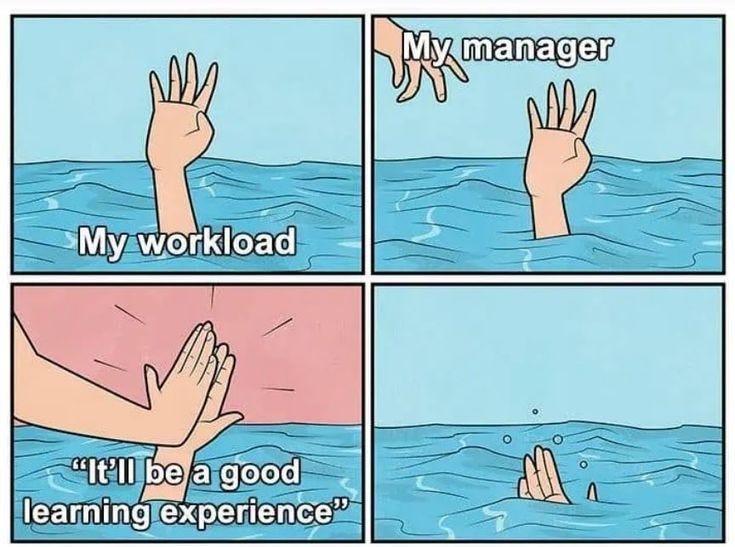
Your relationship with your manager plays a huge role in your success—not only in what you deliver, but in how effectively you can navigate the organization. Each manager has their own priorities, pressures, and expectations, and I was hired—or moved—into the role—to help achieve them.
I take time early on to understand what success looks like from their perspective: their goals for the product, their expectations for my first months, and how they envision the team evolving. But beyond goals, it’s also important to understand how they work. I observe their communication style, clarify how they prefer to receive updates, and discuss how we make decisions together. Important here is also to be very clear on what I need as a professional to succeed on this journey. Do not be shy! Success of your onboarding depends on a million factors but also your approach.
Building this relationship on trust, empathy, and clarity not only aligns our objectives but makes collaboration smoother. This alignment reduces friction, increases transparency, and accelerates the moment when both of us can operate at full speed.
Example 1:
As someone who thrives in chaos—juggling several projects at once and keeping everything aligned—I rely heavily on understanding context, background, and detailed nuances. The fastest way for me to ramp up is essentially a “brain transfer” from someone who has lived the problem space longer. In my case, my manager is exactly that person. For him, what matters most is that the needle moves quickly. To support both our styles, we set up a weekly deep-dive session where I can ask all my “million questions,” clarify assumptions, and connect dots. On top of that, he makes it clear that I can reach out anytime during the week, which creates an open channel that accelerates learning and builds trust.
However, I’ve also been in setups where a manager simply didn’t have the time to invest in regular knowledge transfer. In those cases, the approach from section 3 becomes essential: finding additional sources of information, tapping into experienced colleagues, and mapping stakeholders to uncover the context you can’t get directly from your manager.
Example 2:
I know that for my manager it’s important to hear about incidents or major issues directly and to stay closely informed. Because of that, I make a conscious effort to update him proactively whenever something critical happens. And yes, sometimes the instinct is to wait until the problem is fully resolved before sharing anything but keeping him in the loop early builds trust.
3. Know Your Customers
It’s widely accepted that you can’t build products people value without understanding the people who use them. In every product area I entered, I made it a priority to learn who my customers are and what they need. I looked at the most common customer support questions to identify recurring pain points and patterns, which helped me map the problem space more clearly.
Whenever language allowed, I spoke directly with customers through interviews. When it didn’t, I coordinated interviews through colleagues or external support—an experience that motivated me to start learning German so I can eventually speak with customers firsthand.
Understanding customers isn’t a one-time activity; it’s the foundation for informed decisions, especially when stepping into a new market or product domain.
4. Map Your Stakeholders
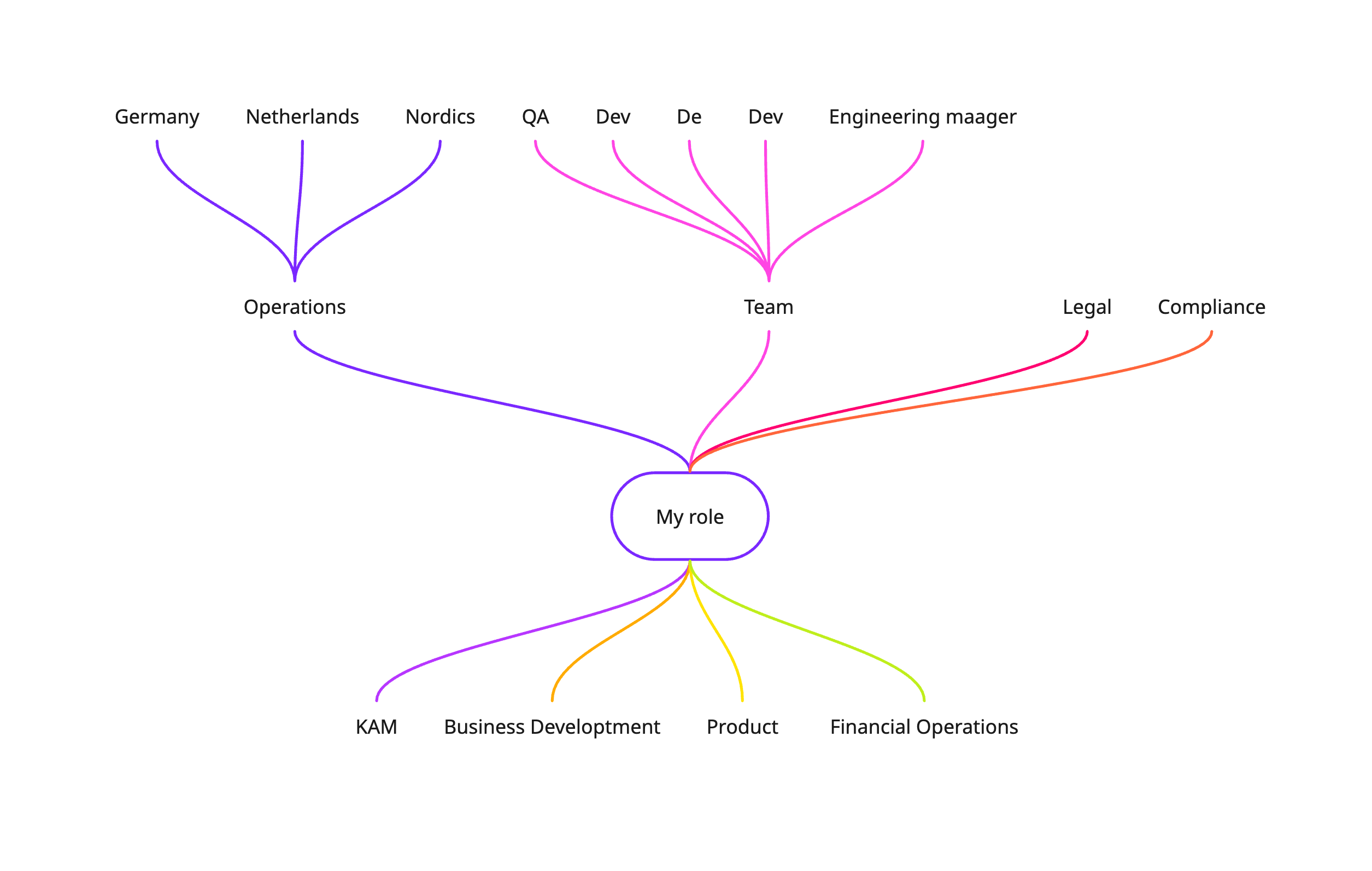
Although I shifted roles and scopes several times within the same company, my stakeholder map was never the same twice. Each product, each team, and each initiative introduced a completely new constellation of people, dynamics, and decision-making patterns. That’s why I always start by building a stakeholder map in Miro as a mind map—capturing not only names and titles but also the real dynamics: who actually makes decisions, who influences them, and who shapes conversations behind the scenes.
I followed the same approach even during my four months as an interim Product Lead. The role was temporary, but the need to understand the ecosystem quickly was just as important. To do this well, I always rely on someone who has been in the organization longer. They can explain the unwritten rules—the relationships, alliances, and power structures that never appear on an org chart. Often, this person naturally becomes a mentor, helping me navigate nuances and avoid common pitfalls.
While mapping stakeholders, I also make a point to ask about past projects, especially the ones that struggled or didn’t go as expected. These stories reveal a lot: where collaboration broke down, who needed more support, and which relationships require extra care. This context helps me understand whom I need to “give more love” to and who might become a strong partner moving forward.
Example:
During one of my role shifts, I learned that the Key Account Management team had a long list of frustrations about the product—missing documentation, unclear processes, and a general feeling of being left out of important updates. Hearing this early in my onboarding helped me understand not only their pain points but also the historical context behind the tension. It immediately showed me where to invest time, rebuild trust, and strengthen collaboration. This insight only surfaced because I proactively asked about past challenges while mapping my stakeholders.
5. Build the Relationships That Matter

With this context in place, I invest deliberately in building the relationships that matter. Collaboration is essential, especially when you’re new, and strong relationships multiply your effectiveness long before you make your first major product move. I focus on establishing genuine, trust-based connections with colleagues—not just understanding their roles, but also what motivates them and how we can support each other.
As a next step, I schedule individual calls with key stakeholders to get to know them personally and understand their perspective on the product and our collaboration. I usually ask three core questions:
What are your expectations from a Product Manager in this scope?
What is not working as expected or currently holding you back?
What should I be aware of—past challenges, ongoing concerns, or dependencies—that can help us work better together?
And whenever I’m in the office, I take the chance to deepen these relationships even further. I schedule lunches, grab a coffee, or organize a casual after-work drink. These informal moments often reveal more than formal meetings: they help build trust, uncover context, and create the kind of rapport that makes collaboration smoother and more effective.
Example:
I also learned early on that the QA team was an extremely scarce resource and often became a bottleneck. To avoid adding pressure and to secure the support I needed, I scheduled a get-to-know call with the QA lead. That conversation helped us establish clear routines and agreements on how to plan testing needs in advance. As a result, I could access QA support when required, while the team remained protected from last-minute stress and overload.
6. Execution in parallel with high standards
Once these foundations are in progress, the shift from onboarding to doing becomes much smoother. With clarity on the goals, the people, and the organizational landscape, I can prioritize effectively and deliver early wins that build credibility. At the same time, I keep learning loops actively observing, asking, challenging, and refining. Mastering a new product or domain is never a one-time effort; it’s a continuous cycle of understanding and adjusting.
From the 4 points above, I already have a huge backlog of items to prioritise from, I pick the ones that contribute to the main KPIs the most and do not have the longest time to market.
And here is something I believe strongly: first impressions matter. A product manager’s early reputation is shaped by how they manage their “brand” inside the organization, how visible their work is, how clearly they communicate, and how reliably they follow through.
I’ve seen many early-career PMs dive deep into execution, successfully launch something, and then unintentionally undermine their impact by neglecting communication. If no one knows what you’re doing or why it matters, it’s much harder to build influence and trust.
Example:
One of the very first things I did in a new PM role was launching an A/B test. And as we all know, A/B tests take time: you set them up, wait for results, and only then make a decision. To avoid leaving stakeholders in the dark, I proactively shared the plan, the timeline, and the key milestones with a broad stakeholder group. Throughout the process, I kept them informed about the progress and interim findings. It took only a few minutes each time, but it made a big difference. The feedback I received later—even during promotion discussions—highlighted that people felt informed, confident, and included. Those “small” communication habits ended up contributing significantly to my growth.
7. Well-Being: Navigating the Emotional Side of Change
When I was starting my career—and honestly, up until about two years ago—these constant changes and shifts made me incredibly stressed. Each new product, each new team, and each unfamiliar domain triggered the same pressure: I need to prove myself again. That feeling can be overwhelming, especially when you’re driven and ambitious.
And who am I kidding? It still happens sometimes. The difference now is that I’ve become more mature in how I handle stress.
A big shift for me came from feedback my manager once shared:
“Please watch out for yourself in terms of sleep and health. Don’t let your high ambitions become the blocker to achieving them.”
It struck me because it was true, I was pushing myself so hard to succeed that I was undermining my own performance. That feedback became a reminder that resilience and well-being are not “nice to have”; they are fundamental to sustaining impact.
Today, I try to build routines and boundaries that support me rather than drain me. I do not skip meals, I do things that I am excited about after work, like organizing community events, writing an article like this, mentoring a couple of amenities, doing regular sports and unwind with friends. I stay aware of my energy levels, make space for recovery, and accept that onboarding into something new is demanding—not because I am unprepared, but because growth always feels like stretching.
Looking back, what once felt overwhelming now feels energizing. Each transition that initially brought uncertainty eventually became a source of confidence. Every new market, every new team, every new responsibility stretched me—and then strengthened me.
To sum it up, below is a framework for stepping into new product domains, moving from understanding business goals and leadership expectations to customers, stakeholders, relationships, and execution. At its core, continuous learning and well-being create a sustainable cycle that turns uncertainty into confident impact.
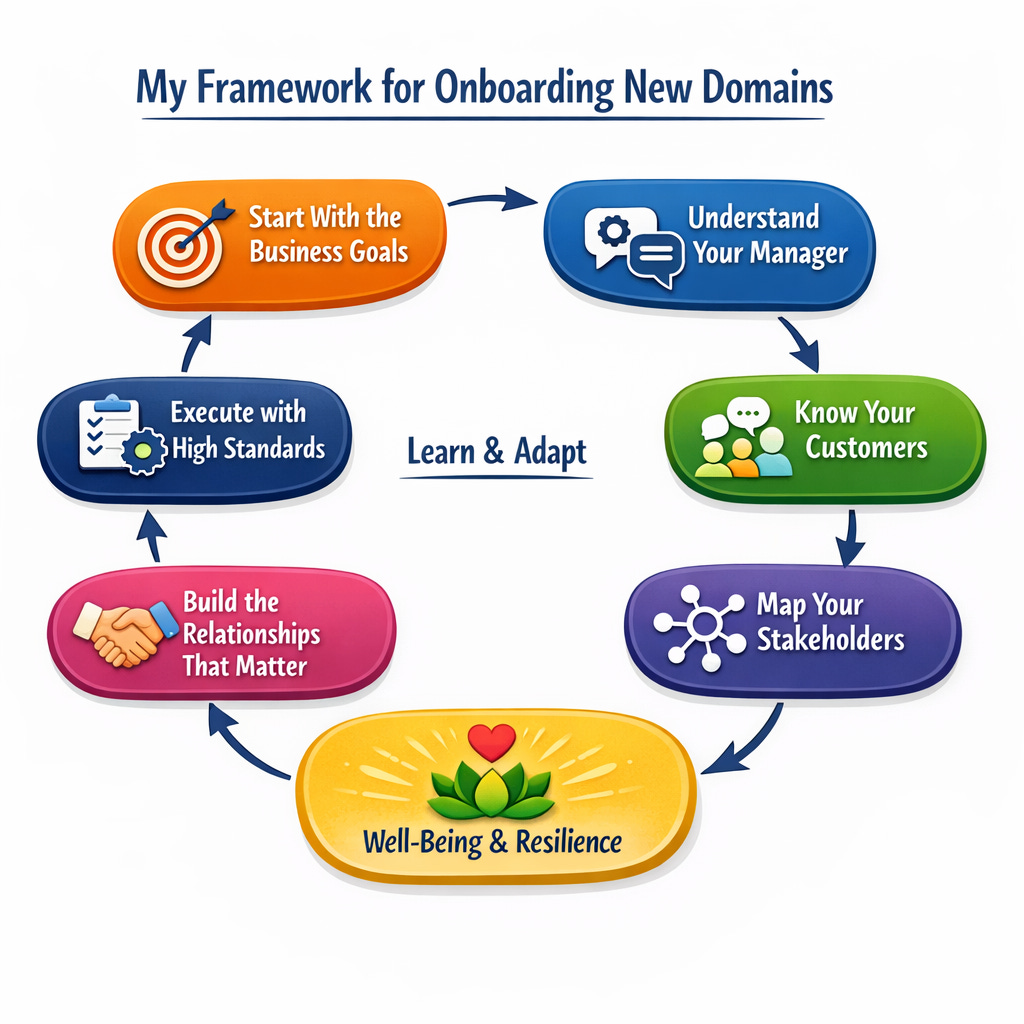
There’s something deeply rewarding about stepping into the unknown and slowly turning confusion into clarity. About walking into conversations where everything feels complex and, a few months later, being the person who brings structure and direction. That transformation never gets old.
Today, instead of fearing the next shift, I’m curious about it. I know there will be moments of doubt. I know there will be steep learning curves. But I also know that I have a way to navigate them.
If you’re about to step into a new product, a new team, or a bigger scope, I wish you courage. Good luck! You’re more ready than you think.
My favorite is the last piece of this article 😊 as I read your framework it all felt like a lot. So many of my questions about your approach were answered just with that last block. One question remains: how do you manage contradictory expectations to product managers discovered in the process of meeting different stakeholders?